
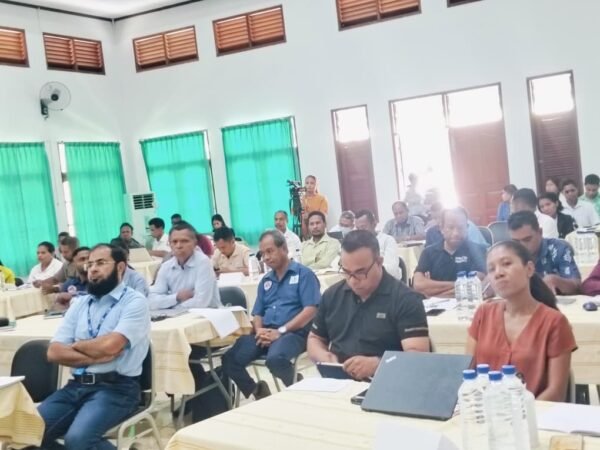
Dili, October 28, 2026 |Média Democracia| – The Timor-Leste Water and Sanitation Platform (PN-BESI-TL), in collaboration with the Directorate-General of Human Resources, Water and Sanitation (DGREAS) and the National Directorate of Water Resources and Sanitation (DNRAS), held a National WASH Forum to strengthen cooperation and cooperation between government institutions, development partners and civil society organizations, to improve access to water and hygienic sanitation in Timor-Leste.
Secretary of State for Electricity, Water and Sanitation (SEEAS), Santos Noronha, said the forum is a space to discuss and find solutions together to the challenges facing the water and sanitation sector in the country.
“We need the participation of institutions and the whole society to pay attention to water and sanitation issues. We know that the water and sanitation sector is very important for the development of the country,” said Santos Noronha to journalists at the João Paulo II Hall, Comoro, in Dili, Tuesday (27/10).
He explained that the Government cannot work alone, but needs collaboration from national and international agencies, public companies such as Bee Timor-Leste (BTL, E.P.), community leadership and other relevant parties.
Santos Noronha also referred to the data he presented, which showed that in 2002, access to good water and sanitation services reached 39.5%. Therefore, he stressed that joint efforts are needed to increase the percentage of access to these services.
“As I mentioned, all parts are important so that we can increase the percentage of 39.5%,” he said.
He added that through the National WASH Forum, all parties can strengthen coordination and work together, although each institution has its own program and responsibility.
He gave an example that the implementation of water and sanitation projects is not the responsibility of BTL, E.P. only. The Government, through programs such as the Municipal Development Program (PDM) and the National Village Development Program (PNDS), together with national, international agencies and other organizations, also implement projects in this area.
Therefore, he hopes that this forum can strengthen understanding and coordination among partners, so that they can work together to achieve common objectives in the development of the water and sanitation sector.
On the other hand, President of BTL, E.P., Gustavo da Cruz, said the institution is currently working together with the Ministry of Public Works (MOP) in the process of road widening in the capital Dili.
He explained that when the MOP team carried out road works, the BTL team, E.P. also work to improve the water distribution system, to prevent damage and ensure that water infrastructure can continue to function properly.
Gustavo da Cruz, also informed, during the process of improving water sewerage, BTL, E.P. detected some consumers who made illegal connections to the water distribution system.
“When we repair the water supply, we detect many consumers who make clandestine or illegal connections. We close these illegal connections and give them the opportunity to regularize their connections, through registration before making new connections and installing meters,” he said.
In addition, he also reported last week, an unidentified person burned a water pipe in the Efaka area. BTL, E.P. has intervened and coordinated with local authorities, community leaders and the Community Police to find out and identify the people involved in the incident.
After detecting the damage, the BTL team, E.P. the water pipe was immediately repaired, and the water distribution system is now back to normal operation.
Meanwhile, Coordinator of the National Sanitation and Hygiene Platform of Timor-Leste, Januario Maral de Jesus, said the forum involves all relevant parties in the water and sanitation sector, including the Government, international development partners, national non-governmental organizations (NGOs) and civil society organizations that focus on sanitation and hygiene.
He explained that the main objective of the forum is to strengthen coordination between partners, to ensure coordinated and effective intervention in this sector.
“We are a strategic partner of the Government to implement policies and programs to achieve the Strategic National Development Plan, especially the 2030 goal, to ensure access to water and hygienic sanitation for all communities,” he said.
He added that non-governmental organizations, in addition to advocacy, also work directly in the villages to support the implementation of the Government’s program.
He also underlined, according to the Government’s plan, investment in the water and hygienic sanitation sector is an important priority, because it is directly linked to public health and the well-being of the people.
Reporting: Octaviana da Costa
Photo: Octaviana da Costa