
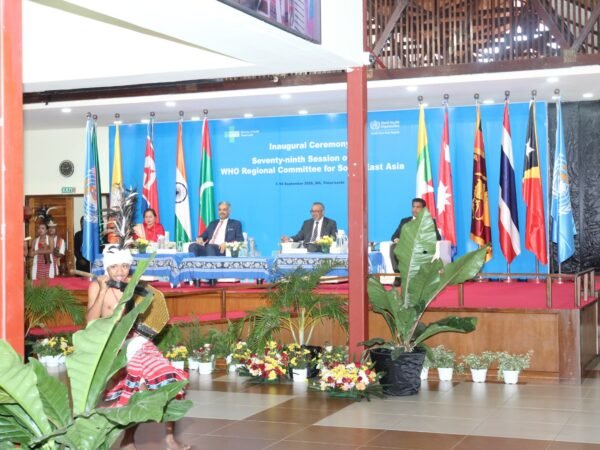
Dili, September 8, 2026 (Media Democracia) – Timor-Leste hosts the 79th Regional Committee Meeting of the World Health Organization (WHO) for the Southeast Asian Region (RC79), with the Government of Timor-Leste placing public health as the main priority in the Southeast Asian region.
At the inaugural ceremony of RC79, the Minister of Health of Timor-Leste, delegations from member countries, WHO leadership and development partners jointly discussed public health priorities in the region.
The main objective of this session is to review progress in health in the region, identify challenges, and determine priorities and strategies for the future. Key issues include tuberculosis (TB), health systems, health human resources, equitable access to specialized health services, universal health coverage, and emergency preparedness.
In her speech at CCD on Monday, the Minister of Health, Élia dos Reis Amaral, emphasized that countries need to continue strengthening regional cooperation, sharing experiences and resources, and increasing investment in health systems to ensure that everyone can access quality health services.
Timor-Leste’s participation in RC79 is very important because it gives the country the opportunity to learn from the experiences of other countries, share national experiences, and strengthen cooperation with WHO and regional partners.
“Discussions on health human resources and TB elimination are also relevant to Timor-Leste’s efforts to improve the national health system. The main point of RC79 isn’t only a meeting about health problems, but also a platform for countries to make joint commitments, set priorities, and seek common solutions to health challenges in Southeast Asia.” said Élia.
She further stated that this is why Timor-Leste is proud and honored to have the opportunity to host this important WHO meeting.
“The Government of Timor-Leste expresses gratitude to the Regional Committee and Member States for trusting and giving Timor-Leste the opportunity to organize this event. The Minister of Health and the Government of Timor-Leste, the leadership of the Regional Committee, WHO leadership, and the WHO Regional Office team worked together with Timor-Leste to ensure that preparations for the meeting went wel.” she affirmed.
She explained that it has been 11 years since Timor-Leste last had the opportunity to organize such a meeting, after hosting it in 2015.
The meeting isn’t only an official event, but also an important forum for sharing knowledge, exchanging experiences, and strengthening partnerships among countries in the Southeast Asian region.
Hosting the event in Timor-Leste also gives opportunities for young health professionals and national institutions to see firsthand how multilateral cooperation and regional health work are carried out.
Timor-Leste’s Health Achievements and Challenges
The Minister of Health said that Timor-Leste has achieved important milestones in health, which are considered the result of the dedication of health professionals, community mobilization, WHO support, and contributions from development partners.
However, Timor-Leste still faces major health challenges. National priorities include TB elimination, combating malnutrition, protecting maternal and child health, and the prevention and control of non-communicable diseases, such as diabetes, hypertension, and cardiovascular diseases.
Therefore, the Government is giving great attention to the Integrated Health Programme (PIS), which is the basis of Timor-Leste’s commitment to achieving Universal Health Coverage (UHC).
“This program integrates services such as disease prevention, diagnosis, treatment, and comprehensive health services, to bring health services closer to communities, especially vulnerable populations. One important principle is to leave no one behind.” she said.
“So, to achieve good health outcomes, Timor-Leste needs to strengthen primary health care and, at the same time, improve secondary and specialized hospital services, with a strong referral system and continuity of health care at all levels.” she added.
Élia also stated that health human resources are the main foundation of the health system. Professionals include doctors, nurses, midwives, laboratory technicians, pharmacists, public health professionals, and community health volunteers.
“Therefore, investing in capacity building, equipment, and health human resource development is a fundamental priority to ensure quality health services for the people. This is also linked to the conference’s strategic agenda, especially the ministerial discussion on Human Resources for Health and Equity in Specialized Care.” said Élia.
She said that Timor-Leste sees this forum as an opportunity to learn innovative strategies from other countries, seek institutional partnerships, strengthen technical exchanges, promote mentoring, develop professional capacity, and improve the health system.
The Timor-Leste delegation will contribute to discussions on disease elimination, health system resilience, and the use of transformative medical technology. In parallel events, topics will also be discussed on women’s health, primary health care resilience, emergency preparedness, and equity in immunization.
On this occasion, the Minister of Health and Mass Media of Sri Lanka, Nalinda Jayatissa, thanked the Government and people of Timor-Leste for taking responsibility to host the WHO Regional Committee meeting and for the hospitality shown to all delegations.
“I also thank WHO and the Regional Office for the good preparations for this event. Timor-Leste is considered the newest country in the region, and hosting the Regional Committee gives other countries the opportunity to learn from Timor-Leste’s experience, see the progress that has been achieved, and understand Timor-Leste’s aspirations for the future of health and development.” said Nalinda Jayatissa.
He said that countries in Southeast Asia have differences in geography, population, economy, and health systems, but they also face common challenges, including the rise of non-communicable diseases.
“Continuing infectious diseases, new diseases, climate change, health emergencies, shortages and pressure on health human resources, and rapid technological transformation all become challenges for the region.” he said.
He stated that the common goal remains to ensure that everyone can get the health services they need, when they need them, and without financial costs that can cause families to suffer.
“This is directly linked to the principle of Universal Health Coverage (UHC).” he concluded.
Reporting: Octaviana Da Costa
Photo: Octaviana Da Costa