
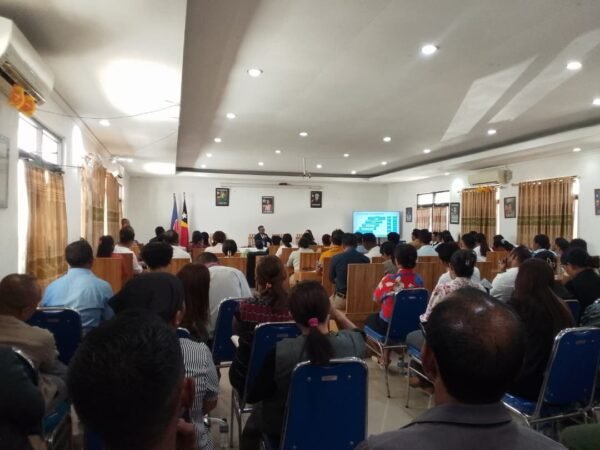
Dili, August 12, 2026 (Media Democracia) – The State Secretariat for Equality (SEI) held a workshop with the theme “Good Management and Governance”, and sub-theme “Legal Procedures for Risk Mitigation and Combating Corruption”. The objective is to increase public servants’ knowledge and strengthen understanding of the regulations, rules, and laws that govern work in public institutions.
The activity was held at the Maria Gorrete Hall, Caicoli, Dili, on Monday (10/08/2026).
According to the Secretary of State for Equality, Elviana Sousa Carvalho, this activity is very important to ensure that public servants understand and carry out their work based on the existing laws and regulations.
“Today, SEI, through the Inspectorate Office, is creating a workshop on good management and governance to increase staff knowledge and strengthen their understanding of the regulations, rules, and laws that govern public servants. In an institution, we need staff to do their work based on existing laws and regulations, and to also understand that each rule and law binds and is created to guide daily work.” said Elviana Sousa Carvalho.
She added that the workshop is also important to give public servants the opportunity to raise their concerns, especially regarding salary, welfare and benefits, including family allowances.
“This one-day activity is very important, because we invited the Anti-Corruption Commission (CAC) and also the Civil Service Commission to come and explain. There are many questions that need answers. That’s why today we are giving staff full time to ask questions and get the opportunity to clarify their doubts about salaries, staff welfare, family allowances and many other things that have been issues for public servants.” she explained.
The State Secretary also stated that the current Constitutional Government continues to make efforts to reform the Civil Service system, with the aim of improving the quality and capacity of public servants.
On the other hand, the President of the Civil Service Commission, Agostinho Letêncio de Deus, expressed appreciation to SEI for inviting the Civil Service Commission to participate in this workshop.
He said that participating in this activity gives the Civil Service Commission the opportunity to share information about the policies and work that the Commission carries out, especially regarding the Single Career Regime and policies on public servants.
“We appreciate the State Secretariat for Equality for inviting us to share the policies that the Civil Service Commission is implementing, related to the Single Career Regime policy. We shared this policy with the State Secretariat, in relation to future careers. This also follows the guidance of His Excellency the Prime Minister to speak with each line ministry about the new policy in the Single Career Regime. At the same time, we also listened to the concerns and challenges that each staff member faces, so we can review and compile a new policy that the Civil Service Commission will submit to the Council of Ministers.” said the President of the Civil Service Commission.
He also said that between 2014 and 2016, public administration agents faced some problems that need solutions. Therefore, the Civil Service Commission continues to seek mechanisms to define a single career for all staff.
He explained that the recruitment process or transition from casual agents to permanent staff cannot happen automatically, but must go through a clear process and follow the rules.
According to him, currently there are about 24,000 casual agents who need a solution regarding their status. The Civil Service Commission, together with the Prime Minister and members of the Government, continues to seek a solution to this issue to bring it to the Council of Ministers to clearly define the transition process.
In addition, he said another challenge public servants face is salaries that don’t match their career level, and the salary gap between new staff and staff who have worked for a long time.
“The challenge that the current career brings is that there are many problems. We see that there is imbalance, especially regarding salary adjustment. In some cases, new staff who have just joined can receive a higher salary than senior staff. There is a difference between the special regime and the general regime, and the salary differences that staff face.” he said.
He added that all these problems need to be solved by improving the system, to guarantee justice, balance, and fairness in the remuneration system for staff who work for the State.
“All problems have solutions. The Civil Service Commission will propose to improve the system, so that the system can have justice and balance, including fair salaries and adjustments for staff who are doing their work.” he concluded.
Reporting: Trainees lourenço and Nicodemus
Photo: Nicodemus