
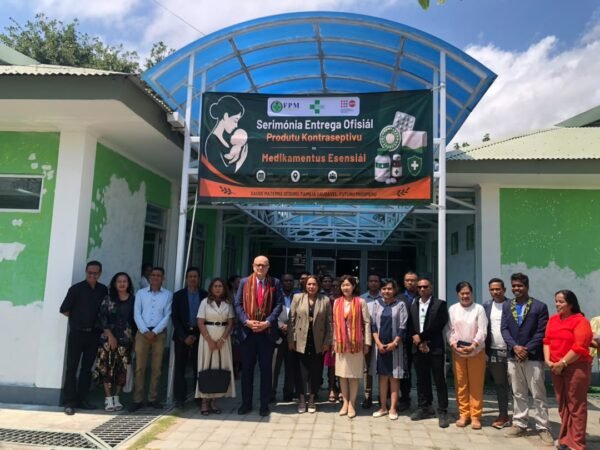
Dili, September 10, 2026 (Media Democracia) – The United Nations Population Fund (UNFPA) delivers contraceptive products and essential medical equipment to the National Institute of Pharmacy and Medical Products (INFPM), to be distributed to health facilities to meet the needs of pregnant women, women, adolescents, and children in Timor-Leste.
According to UNFPA’s Regional Director for Southeast Asia, Aleksandar Sasha Bodiroza, he said that this delivery is important to ensure the availability of essential reproductive health products, especially contraceptives.
“Today we are gathered to deliver contraceptive products and essential medicines, especially contraceptives, such as the injectable Medroxyprogesterone Acetate, Implanon NXT and Misoprostol, which are an important part of UNFPA’s program support to improve the availability of essential reproductive health products in this country,” said Aleksandar Sasha Bodiroza in his speech at the INFPM Hall, Thursday (10/09).
He said that these products are not just equipment or medical products, but represent choice, dignity, and opportunity for women and girls to have a healthier and safer future.
“When a woman can decide if and when she wants to become pregnant, she has greater control over her health, family, and future. Likewise, when a mother gives birth and has access to essential medicines at the right time, we can save her life,” he said.
According to him, UNFPA remains committed to ensuring that women and girls have access to quality and safe sexual and reproductive health products.
“Through our global-level procurement mechanism, we work with countries and partners to ensure quality supply, leverage the global market, and strengthen supply chains, to ensure that these products reach the people who need them most,” he explained.
He also said that in the Asia-Pacific region, UNFPA works with governments to strengthen components of the supply chain, from forecasting and financing, procurement, storage, distribution and availability all the way to the “last mile.”
UNFPA recognizes that a medical product is only effective when the product is physically available in the right place and at the right time, when a woman needs it.
“Timor-Leste has made important progress in strengthening the health system and expanding access to sexual and reproductive health services, and UNFPA is proud to be with the Government as a partner on this journey,” he said.
However, he said that long-term sustainability also needs to be a priority.
“Today is not only about what we deliver at this moment. We also have to ask ourselves: how can we ensure that these products will be available tomorrow, next year, and in the years to come? This is where long-term sustainability is really important,” he stated.
Although external financing and support from development partners play an indispensable role in supporting access to reproductive health products in many countries, including Timor-Leste, the current external financing situation shows the need to further strengthen national ownership and sustainable financing.
The Government of Timor-Leste has already invested approximately US$1.6 million through the Third-Party Procurement (TPP) mechanism to purchase reproductive health products. Meanwhile, UNFPA, in recent years, has helped increase this investment through budget support of approximately US$2.3 million from complementary resources through the Match Fund.
Therefore, he considers this delivery as a moment to celebrate progress and reaffirm the commitment to continue investing in sexual and reproductive health, strengthen the national system and supply chain, mobilize sustainable financing, and ensure that no woman or girl is left behind.
UNFPA, he said, remains committed to working with the Government of Timor-Leste, health workers, communities, and development partners to make this vision a reality.
“Let us continue to move forward together, from access today to sustainable access tomorrow,” he said.
On the other hand, the Executive Director of INFPM, Paula Mendonça, stated that these products, including injectable contraceptives, implants, pills and other essential reproductive health products, will directly contribute to ensuring the availability and continuity of essential services for women, adolescents, and families across Timor-Leste.
“For INFPM, this delivery ceremony does not end with the transfer of products. This is our responsibility to ensure that these products are received well, stored safely, managed appropriately, and distributed on time, so that they can reach health facilities and, ultimately, the women and families who need them,” said Paula Mendonça.
She said that INFPM has an important role in the national supply chain for medicines and health products, through the central warehouse in Dili and regional warehouses.
“We work to ensure that products are available and distributed to public health facilities across the country. We recognize that a strong health product supply chain not only requires sufficient products in the warehouse,” she said.
She explained that a supply system also needs accurate forecasting and quantification, an effective Supply Plan, appropriate procurement, good inventory management, proper storage, timely distribution, credible data, and strong coordination among all stakeholders.
Paula Mendonça stated that INFPM greatly values the technical support and collaboration that UNFPA has provided over the past years.
“This partnership has helped strengthen not only the availability of reproductive health products, but also the systems and capacity needed to manage these products effectively,” she said.
She said that Timor-Leste has entered an important phase in the process of increasing national ownership and sustainable financing for reproductive health products.
“The development of the National Supply Plan provides an important basis to link product needs with available financing, identify gaps, and support procurement decisions. This plan will continue to be an important tool for INFPM and the Ministry of Health in planning and managing the supply of essential products,” she stated.
INFPM also recognizes the importance of strengthening domestic financing. The Government has shown its commitment through an investment of close to US$1.6 million through the Third-Party Procurement (TPP) mechanism for reproductive health products. At the same time, UNFPA complements this investment with US$2.3 million through the Match Fund mechanism.
She considers this an important example of how the Government and development partners can work together to respond to current needs, while at the same time paving the way for greater national ownership.
As the national institution responsible for pharmaceutical and medical product management, INFPM is committed to strengthening systems and capacity to support the Ministry of Health in ensuring continued availability of essential medicines and health products.
“We will continue to work to improve inventory management and stock monitoring; storage and warehouse management; timely distribution to health facilities; use of data from the logistics information system; and strengthening coordination with the Ministry of Health, UNFPA, and other partners,” she explained.
She emphasized that the success of a supply chain is not measured only by the quantity of stock in the warehouse, but by one question: is the right product in the right facility, at the right time, and in the right quantity?
INFPM, she said, looks forward with interest to continuing the partnership with UNFPA and the Ministry of Health, while strengthening the national supply chain and preparing for a more sustainable future.
INFPM is also ready to continue collaboration in areas such as Supply Planning, forecasting and quantification, supply chain management, data use, capacity development, and innovative financing mechanisms.
Reporting: Estefània Cardoso
Photo: Estefània Cardoso