
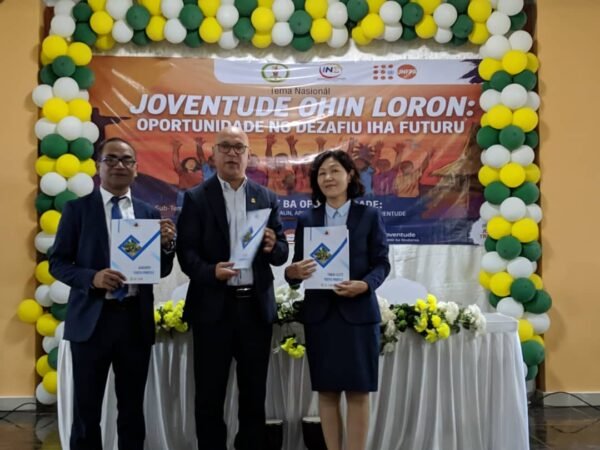
(MJDAK) holds Launch of National and Municipal Youth Profile, with the theme “Youth Today: Opportunities and Challenges for the Future”, to provide space for young people to know and understand the opportunities, challenges and perspectives of youth development in Timor-Leste.
According to the Minister of Youth, Sports, Arts and Culture (MJDAK), Nelyo Isaac Sarmento, Timor-Leste currently has a population of around 1.3 million people, and the majority of this population are youth aged between 15 to 35 years old. According to available data, most young people live in rural areas and still do not have adequate access to education, professional information and job opportunities.
“According to data on youth in Timor-Leste, out of our population of 1.3 million, youth aged between 15 to 35 years represent a large percentage. This data shows that the Government must pay attention, not only the Ministry of Youth, Sports, Arts and Culture, but all ministries must look at how to make plans and investments based on this data,” said Nelyo Isaac Sarmento at the MJDAK building, Tuesday (11/08/2026).
He added that the majority of youth, the largest number, live in rural areas and face limitations in access to education, professional information and job opportunities. Job opportunities do not only mean working in an institution or company, but also include opportunities for youth to create and develop their own entrepreneurial activities.
Nelyo Isaac Sarmento emphasized that the large number of youth represents important potential for the country’s future. Therefore, the Government needs to make good and strategic investments in youth, in order to increase the quality of Timor-Leste’s human resources.
“This large number represents great potential for our country. If we make good and strategic investments for the future, we can have a quality population. That’s why I say that investment in youth is not an expense, but an investment to get returns for the nation’s future. How this country will move forward and become quality depends on what we invest in right now,” he said.
He also said that youth issues are not only the responsibility of MJDAK, but are a shared responsibility of all government ministries and institutions, according to each area and competence.
“Youth is not only the responsibility of the Ministry of Youth, Sports, Arts and Culture. This is a shared responsibility, because all ministries are connected to people and to youth. For example, youth who face health problems, this is not an MJDAK program, but the Ministry of Health must look at and respond to this problem,” he explained.
He also referred to the problem of youth who drop out of school and do not continue their education, which, according to him, needs attention from the Government and relevant ministries.
“Some youth, almost every year, drop out of school and do not continue their studies. This problem is not the responsibility of just one ministry, but is a national problem. Each ministry according to its area must pay attention and seek solutions to this problem. That’s why I think that the data we get is very important, so that later we can make good programs and investments for our country,” he concluded.
In addition, the representative of the National Statistics Institute of Timor-Leste (INETL), Silvino Lopes, said that statistical data is very important to help us know and discover the problems that Timorese youth face, especially in future development planning.
“The National Statistics Institute is the institution responsible for processing and producing statistical data in Timor-Leste, especially data on the youth profile. But statistical data is not just numbers. Relevant institutions must use this data well to support the planning and development process, especially in the youth area,” he said.
He emphasized that often people interpret statistical data as just ordinary numbers, but in reality, behind those numbers is people’s lives, especially the lives and situation of youth in Timor-Leste.
According to him, the large youth population in Timor-Leste shows two important things. First, Timor-Leste has a young, energetic, creative population with great strength to contribute to national development. Second, this situation is also an important opportunity for Timor-Leste to use the demographic dividend to promote economic and social development.
He said that to realize the dreams and hopes for the future of youth, Timor-Leste needs to continue investing in education, health and the labor market. If these areas do not get adequate attention and development, opportunities for youth to have a good future will be limited.
“If we don’t make good investments in education, health and the labor market, it will be difficult to realize our dreams, especially for youth in the future. The data shows that there have been changes and progress, but we need to continue to look at how to increase opportunities for children and young people,” he stated.
He also referred to data from 2003 to 2019, which showed a change in the fertility rate. In the earlier period, the fertility rate in Timor-Leste was high, with women having up to nearly 7 children. But, with the development that has happened, especially in the areas of education and health, that rate has dropped to nearly 3.6.
“This data shows that there is change in society and development. But, we must prepare youth to become people who have capacity for the future, not only to be a workforce, but to be an important force for national development,” he concluded.
Report By: Trainees Lourenço and Fizania
Photo: Trainee Fizania