
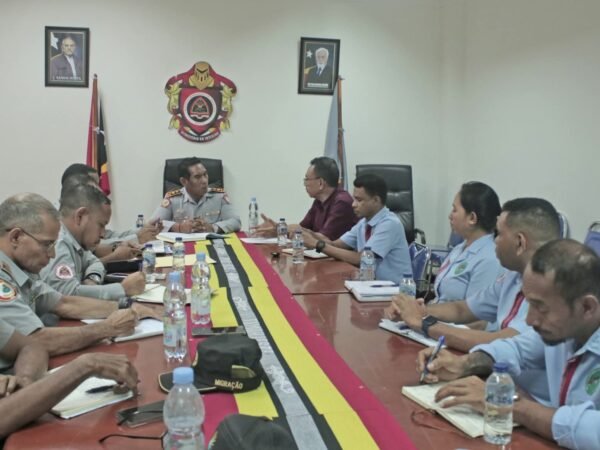
Dili, September 4, 2026 (Media Democracia) – The National Institute to Combat HIV/AIDS (INCSIDA) of Timor-Leste held a coordination meeting with the Deputy Regent of Belu and relevant leaders in Atambua, Indonesia, to discuss a joint awareness campaign in the border area to reduce the risk of HIV-AIDS transmission and protect communities in both countries.*
According to INCSIDA President Daniel Marçal, Timor-Leste is very concerned about the HIV-AIDS problem, especially because community movement in the border area with Indonesia is easy and happens frequently.
According to INCSIDA, HIV-AIDS awareness has already been carried out in municipalities, administrative posts, villages and hamlets in Timor-Leste. Although these activities have covered many areas, INCSIDA considers that HIV-AIDS prevention is not only an internal matter for Timor-Leste, but also requires cooperation with the Indonesian side.
“HIV-AIDS is not only our internal problem, because we have a border that is very easy to cross. We are very close to communities from Indonesia.” said INCSIDA.
The President explained that the movement of people in the border area between Timor-Leste and Indonesia is not movement that requires a passport or all travel documents, because communities on both sides of the border have social relations and daily activities.
Because of this, INCSIDA considers it important to reduce the risk of HIV-AIDS transmission in Timor-Leste and also in communities on the Indonesian side, especially in border areas such as Suai, Bobonaro and Oe-Cusse, which are close to Atambua, Kefamenanu and Malaka.
INCSIDA said that they are already in the process of cooperating with the Indonesian AIDS Prevention Commission (KPA), to facilitate joint activities in the border area.
According to INCSIDA, the objective of this cooperation is to facilitate joint awareness, education and HIV-AIDS prevention activities between institutions from Timor-Leste and Indonesia.
However, INCSIDA said that the administrative process to establish the cooperation mechanism has not yet been completed, because it needs to go through procedures and authorities in both countries.
“The process started several years ago. We held meetings with KPA, then the documents were sent to Jakarta. The process is very long.” he said.
The President also added that some time ago, they had already received a letter of authorization to carry out joint activities with authorities in Atambua and Kupang. But when the process reached Kupang, the procedures had to be repeated, which made the process even longer.
He said that, until now, the documents are still in process at the Indonesian Ministry of Foreign Affairs, and the Timor-Leste side continues to coordinate with the Indonesian KPA.
Because the process is long, INCSIDA considers it important to have a simple agreement or temporary mechanism that can facilitate joint activities on the border, while waiting for the formal documentation process.
“Just a few points, like a simple agreement, can help us to carry out joint activities on the border. This small document is not like an MOU, but a joint agreement.” he explained.
INCSIDA also said that they have held meetings with authorities in Atambua, including the Deputy Regent of Belu and relevant health institutions, to discuss HIV-AIDS prevention in the border area.
According to INCSIDA, the meeting showed that Indonesian authorities are also concerned about the HIV-AIDS problem and are ready to support joint efforts to protect communities on both sides of the border.
He stressed that HIV-AIDS has no borders, passport or travel documents. Therefore, movement of people on the border and social relations, including sexual relations, can be factors that increase the risk of transmission.
“One thing about HIV-AIDS is that it moves around with no passport, no visa. HIV-AIDS is directly linked to people’s basic needs, including sexual relations.” he stated.
Because of this, INCSIDA hopes that cooperation between Timor-Leste and Indonesia can find a quick solution, especially to facilitate awareness, prevention, testing and education activities on HIV-AIDS for communities in the border area.
INCSIDA considers cross-border cooperation very important, because HIV-AIDS prevention needs to involve both countries and communities on both sides of the border.
Reporting: Tomás Dos Santos
Photo: Tomás Dos Santos