
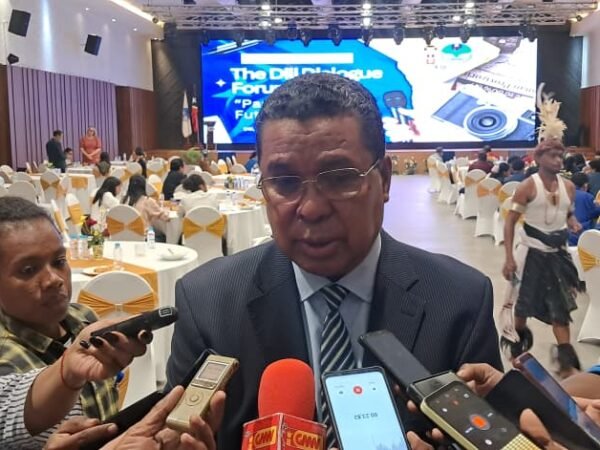
Dili, 14 May 2026 (Media Democracia) – Human Rights and Justice Ombudsman (PDHJ) Virgílio da Silva Guterres “LAMUKAN” said the work of journalists is full of risk, and warned that attempts to re-criminalize defamation in the Penal Code violate human rights, and therefore press freedom, which is meant to guarantee quality information for the public.
“So the public can trust us, online media can be measured by live comments and feedback,” PDHJ highlighted the theme “Journalism for Peace” to reflect reality. “We see society living in harmony, but in Hera Akadiru-Hun they destroyed the party and fought until there were victims. So peace is still not the same across all of Timor. The incidents that keep happening show there are social problems.” said the Human Rights and Justice Ombudsman Virgílio in the GMN Multi-purpose Hall this Tuesday (12/05).
The Ombudsman asked the media to be careful with content, not to become a place to dump garbage, and not to give the public matters that have no value. They must ensure that what is written and published has value for the public.
“The job of a journalist is not just to interview people, but the risk is constant and requires courage. If there is no risk, people cannot take risks, they cannot be journalists. If we look at the Balibo Five, Kamal Bamadhaj, Sander Thoenes who died here, we all know this reminds us that journalism is risky. Seeking the truth is a big risk. When we investigate corruption that affects public interest and company interests, that’s a big risk.” he said.
Therefore, he asked to strengthen the media and journalists’ courage to continue contributing and improve their role as an instrument for building peace, but threats will still exist if some policies limit it or some individuals threaten it.
He also asked journalists not to stay silent. When they receive threats, they should inform journalist associations like TLPU, AJTL, or UPJTL, so the associations can provide protection and seek a lawyer for legal support.
“The Social Communication Law states clearly: any public official who obstructs a journalist’s work commits a crime. So if the threat is related to this, journalists have the capacity. The Human Rights Ombudsman also has a responsibility under UN resolutions to defend human rights defenders. Journalists who cover peace and peacebuilding are part of defenders. The Ombudsman can also do advocacy to defend journalists’ work.” he added.
In addition, Virgílio reminded security forces, especially the PNTL institution, that when they beat citizens, that is a crime. A public official betrays their oath and honor when they become police to serve the people, but then hit a citizen. That is like hitting the people. So beating a civilian is a crime against the public official code. Whether prison guards, police, or military, beating civilians is not just a violation of rules, but a violation of the foundation of the State.
Virgílio da Silva Guterres informed that he has heard the government is currently proposing amendments to the Penal Code Law. There, the intention is to criminalize defamation, so the Ombudsman has instructed PDHJ’s legal team to review the law.
“If this intention comes up again, we in Timor made an oath to speak but not follow through. Defamation was already criminalized in 1999, during the transitional government period, through Sérgio Vieira de Mello’s executive order as subsidiary law. Criminalizing defamation violates human rights, including the subversion law.” he said.
Because of this, he stressed that it’s time to throw out the garbage that’s over 24 years old, after commemorating the 20th of May Restoration of Independence Day. From the First Government onwards, there have been attempts to criminalize defamation, where journalists together with civil society campaigned and did advocacy.
Report By: Tomás and Trainee Leozalia
Photo: Tomás