
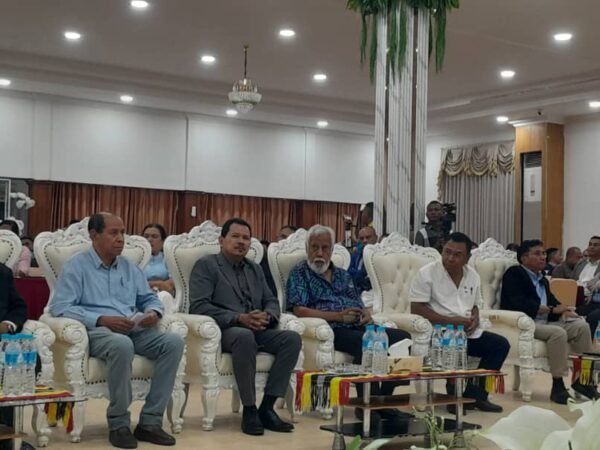
Dili, August 17, 2026 (Media Democracia) – Prime Minister Kay Rala Xanana Gusmão, together with the Ministry of Public Works, held a hearing with national businesspeople, with the theme “Strengthening Partnership Between the Government and the Private Sector in the Development of Timor-Leste’s Economic Infrastructure”, at the Delta Nova Hall, Thursday (13/08/2026).
On this occasion, Prime Minister Kay Rala Xanana Gusmão said that Timor-Leste is in the process of two constructions: the construction of the State and the construction of the Nation. The construction of the State involves institutions such as the Presidency, Parliament, Government, Justice and other State institutions, with the objective of strengthening public service and improving service delivery to the people.
“Self-determination has two processes. First, the construction of the State, which talks about State institutions: the Presidency, Parliament, Government, Justice and others. Work with heart and work well so that we can serve this country. In 24 years of independence, we still have many weaknesses in the construction of the State,” said the Prime Minister.
He said that the second process is the construction of the Nation, which requires the State together with the private sector and other stakeholders to promote national economic development.
“The second process is the construction of the Nation, where the State is together with the private sector. In other countries the private sector runs on its own, but in Timor-Leste we are just starting. The State must find ways to use the capacity of the private sector to open the way for economic development, because even though we have been independent for 24 years, we still feel very sad because the economy is still weak,” he said.
The Prime Minister also gave the example of local products, especially Atsabe coffee, which is considered a product with potential to develop the private sector, especially women’s and youth businesses.
He said that young people must be involved in the development of national infrastructure and the economy, because opportunities in the private sector can be a way to create jobs and increase youth participation in nation building.
The Prime Minister also emphasized the importance of decentralizing development, especially in rural municipalities, so that local communities, women and youth can get opportunities to develop their capacity and create economic activities in their own areas.
“Through decentralization, development and infrastructure, we have to look at each community, especially young people, through concrete action. We have to train them to have capacity and contribute to this country,” he said.
He also asked businesspeople and Timorese who already have capacity to continue to prepare themselves and increase their capacity, especially in the infrastructure area which is still incomplete.
The Prime Minister said that the Government needs to continue to look at development in all municipalities, including Aileu, Ainaro, Covalima, Baucau, Bobonaro, Ermera, Liquiçá, Manufahi, Manatuto, Viqueque and Lautém.
He also stressed that decentralization and infrastructure development are very important to ensure economic opportunities are distributed fairly to communities in all municipalities.
“Through decentralization and infrastructure development, we look at each community. The legal instruments and financial laws that we adopt must look at capacity and development. We also have to look at the classification of municipalities, from the lowest level to the highest, and all experiences in State infrastructure development,” he said.
The Prime Minister also declared that joint efforts between the Government and the private sector need to be based on evidence, justice and competence, in order to continue improving the system and develop the national economy.
He said that during 24 years of independence, Timor-Leste has managed to build and strengthen the nation with limited resources, and now is the time for the State, private sector, civil society and other stakeholders to work together to prepare the country’s future.
“We can make joint efforts. With evidence, justice and competence that have recently been treated very well and very competently this year. We have celebrated 24 years of independence. We did not receive weapons from abroad, but we complement each other and have confidence in our own capacity,” he said.
He also informed that on October 22 and 23 there will be a conference that will give everyone the opportunity to share ideas and seek solutions together for the development of the private sector and the economy of Timor-Leste.
“This conference is not coming to criticize you, but to let you know that we are already moving, but it is not yet good. All of us have to work together, because the construction of the State needs to be together with institutions, civil society and the private sector to find ways forward to facilitate and develop this country,” he said.
Meanwhile, the Minister of Public Works, Samuel Marçal, said that the Government needs to continue to develop strategies to develop the private sector, because this sector has a very important role in national economic development.
He said that in the past, in each municipality there were not many businesspeople and most faced economic difficulties. But, through the implementation of development programs and project packages, including PDD and PDL, the number of businesspeople has started to increase.
“I think the classification of reference packages must be in the right groups. The Prime Minister, after taking over the Government, looked for strategies on how to develop the private sector, because various models show that the private sector is very important in this country,” said Samuel Marçal.
He said that the Government continues to pay attention to the private sector because a strong capacity in this sector can help move the economy, increase production and create job opportunities for youth.
“With the strong capacity of the private sector, our economic circulation can be good. Production from the private sector can increase, and the Government has started investing in the private sector. It is from the private sector that jobs for our youth can be created,” he said.
The Minister of Public Works also said that the Government is not only giving projects to businesspeople, but needs to make investments that can stimulate the private sector to create new opportunities and increase employment for youth.
He also stressed that the private sector must continue to innovate and develop local products, in order to increase production and Timor-Leste’s export capacity.
“The Government’s thinking is not just to give projects, but to invest in the private sector and find ways to create other investments, in order to open jobs for our youth. The private sector must continue to innovate and develop our local products,” he said.
Samuel Marçal also acknowledged that the Government has its limitations and some failures, and this hearing with businesspeople is an opportunity to hear directly their thoughts, criticism and suggestions to improve Government policies and programs.
“Today we are here and we acknowledge that the Government also has many failures. Because of that, we want to hear all of your thoughts to improve our country. You may also have failures, but you must not be afraid and you must not be ashamed. We are all children of Timor and have the responsibility to work together to improve this country,” he said.
He also gave the example of Atsabe coffee which has found a market in Singapore. He said that this situation shows that Timor-Leste has local products that can compete in the international market if production and quality continue to improve.
“Recently I went to Singapore, I went to drink coffee and I saw Atsabe coffee produced from Timor. We must continue to uphold our vision. The Government and the State must move forward. If we all just wait for someone to develop our country, sometimes we will face problems,” he said.
Samuel Marçal emphasized that the private sector needs to be an important part in the construction of the national economy, by taking advantage of opportunities in both local and international markets.
He believes that, with joint efforts between the Government, private sector, civil society and the community, in the next five years Timor-Leste can have a strong private sector and guarantee for the country’s economic future.
Reporting: TraineesSantinha and Fizania
Photo: Trainee Fizani