
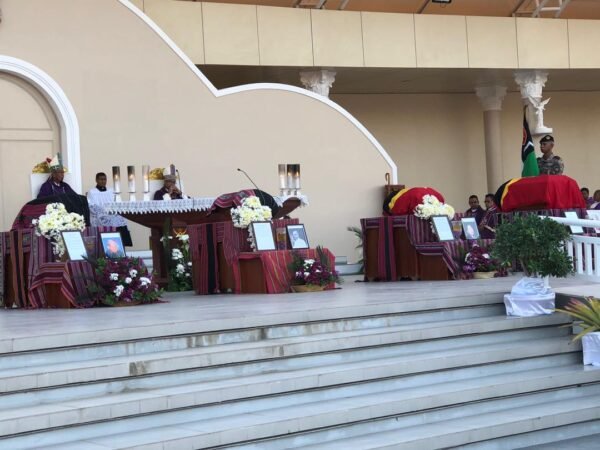
Dili, September 2, 2026 (Media Democracia) – The mortal remains of the Three Bishops, who made a great contribution to the development of the Catholic Church and the people of Timor-Leste, have returned to the land of Timor-Leste and were received by the Catholic community through a Mass ceremony in Tasi-Tolu, Dili.
The urns containing the mortal remains of Dom José Joaquim Ribeiro, Monsignor Martinho da Costa Lopes, and Dom Alberto Ricardo da Silva are considered a historic moment for the Catholic Church and the people of Timor-Leste, because these Church leaders dedicated their entire lives to the service of the Church and the people of Timor-Leste.
The Mass celebrant, Bishop of the Diocese of Maliana, Dom Norberto do Amaral, said that the presence of these mortal remains in Timor-Leste marks an important moment in history, because they have returned to the land where they worked and dedicated their lives.
“Today we bring back the mortal remains of the Bishops of Timor to Pope Francis’ plaza. Tasi-Tolu is marking history again for the fourth time with mortal remains.” said Dom Norberto at the opening ceremony for the Four Bishops in Tasi-Tolu, Tuesday afternoon (01/09).
Dom Norberto said that before this, there were other great moments that marked Timor-Leste’s history, such as the first visit of Pope John Paul II, the Restoration of Independence, and the visit of Pope Francis.
Now, the return of the mortal remains of Church leaders is another historic moment for the nation. The mortal remains brought back to Timor-Leste include Dom José Joaquim Ribeiro, Monsignor Martinho da Costa Lopes, and Dom Alberto Ricardo da Silva.
Dom Norberto emphasized that they didn’t come as foreigners, but have come back to their own land and their own home.
“These words are very important because their lives, work, and sacrifice in Timor-Leste became part of the history of the Church and the people of Timor.” he said.
Dom Norberto also recalled the contributions of Dom Jaime Garcia Goulart and Dom Jaime da Silva, who led the Church in Timor during an important period in history.
“Dom Jaime faced difficult situations, including the Japanese occupation and the destruction of infrastructure in Dili. Despite these conditions, he continued to organize the Diocese structure, strengthen the formation of catechists, and opened the Major Seminary to prepare Church leaders for the future. Dom Jaime’s work became an important foundation for the formation of leaders who now contribute to the Church and Timor-Leste society.” he said.
After Dom Jaime Garcia Goulart, Dom José Joaquim Ribeiro continued the work as Bishop of Timor. He led the Church from 1967 to 1977, including during the time of political conflict and violence in 1975.
In his homily, Dom Norberto recalled the story that Dom José Joaquim Ribeiro himself told about the situation during the conflict, including when he visited seminarians who had taken refuge in Fatumaca.
“Dom José also reported on the condition of the people in Dili, who suffered because of violence, lack of food, and many people were injured. At another time, Dom José said that he saw a person die on the beach and he himself buried that person because there was no one else who could do it. He also criticized the ‘popular judgments’ that happened during the conflict, with an appeal to avoid violence and to love one another.” said Dom Norberto in the homily.
Dom Norberto said that these messages showed Dom José’s courage to speak out against injustice and violence, even though he himself faced difficult situations.
Monsignor Martinho da Costa Lopes served in Bobonaro and was the first Timorese priest. He also contributed to education through the opening of Colégio Infante de Sagres in Maliana, before coming to Dili and taking on important responsibilities in the Church.
During the Indonesian occupation, Monsignor Martinho spoke out strongly against the violence and abuses that occurred in Timor-Leste, including in Kraras.
Because of his stance, he faced pressure from the Indonesian authorities and eventually left Timor-Leste. He lived in Portugal until he died.
Meanwhile, Dom Alberto Ricardo da Silva continued Church leadership during the final period of the Indonesian occupation and the transition to independence.
Dom Norberto recalled that Dom Alberto faced difficult moments, including the events of 12 November 1991, when a student and youth demonstration at Santa Cruz ended with many people killed and injured.
At that time, Dom Alberto became an important voice for the people, especially in defending the right to life and human dignity.
During his leadership, Dom Alberto also spoke strongly about family planning and the protection of life, and defended the moral principles of the Church. He was also part of movements that made public positions on religious and moral matters.
Dom Norberto said that the mortal remains of the bishops now in Timor-Leste are not just the remains of people who have died, but have become a symbol for the Church and the people of Timor-Leste.
“Now they are no longer physically among us, but their mortal remains are with us. We receive them with joy.” said Dom Norberto.
He stressed that their legacy can be an inspiration for the new generation to continue building, strengthening, and nurturing the Catholic faith and human values in Timor-Leste.
He also referred to the teachings from the Book of Daniel about wise people who taught many people to walk on the path of justice and to shine like stars for others.
Bishop of the Diocese of Maliana, Dom Norberto do Amaral, expressed gratitude for the contribution and sacrifice of the Church leaders who dedicated their whole lives to God and the people of Timor-Leste.
He appealed to the people to learn from their example, especially regarding working wholeheartedly, sharing with others, justice, love, and forgiveness.
“The mortal remains that are now with us can be a sign that they are with us, because we and they are one.” he said.
Dom Norberto also asked forgiveness for the mistakes that the people of Timor-Leste have made and asked God to grant endless mercy to the nation and the people who continue to journey in this world.
Before ending the homily, he appealed to the people of Timor-Leste to continue to love, to work, and strengthen unity, so that the legacy of the bishops and missionaries becomes a guide for future generations.
Reporting: Estefánia Cardoso
Photo: Estefánia Cardoso