
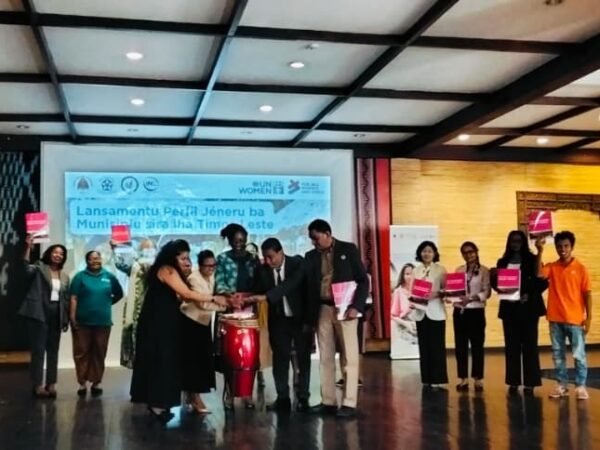
Dili, August 19, 2026 (Media Democracia) – Government of Timor-Leste, through the Secretary of State for Equality, together with the National Statistics Institute of Timor-Leste, I.P. and the United Nations (UN) in Timor-Leste, launched the Municipal Gender Profile, as an important tool to identify gender gaps and challenges in the municipalities, determine investment priorities, and strengthen gender-responsive planning, policy development, budgeting, service delivery and monitoring.
According to the Secretary of State for Equality, Elvina Sousa Carvalho, the Government, through the Secretary of State for Equality, worked together with the National Statistics Institute of Timor-Leste, I.P. (INETL), with technical support from UN Women, to finalize the Municipal Gender Profile that was launched today.
“This profile is important to determine investment priorities and to strengthen planning, policy development, budgeting, service delivery and gender-responsive monitoring. This data will guide us to increase women’s access to education and available employment opportunities. Through this data, we can intervene with the target groups.” said Elvina Sousa Carvalho to journalists at Hotel Timor, Dili, Tuesday (18/08).
She said that this official document has great relevance for the development and decentralization agenda in Timor-Leste, because it provides practical evidence for municipalities and national institutions to identify gaps and challenges in the area of gender.
“Through this data, we can make plans. This data becomes the basis to develop better policies and programs that respond to community needs.” she said.
On the other side, President of the National Statistics Institute of Timor-Leste, Elias dos Santos Ferreira, said that the Municipal Gender Profile was launched because INETL worked together with the Secretary of State for Equality, with technical support from UN Women, to finalize a profile for each municipality.
“This report is part of the Household Census data. Today we launched the Municipal Gender Profile for each municipality, and later it will be handed over to the Ministry of State Administration to be published on the portal.” said Elias dos Santos Ferreira.
He also said that this profile will be an important reference for institutions to use data in the planning process, including in the discussion and preparation of the 2027 General State Budget (OGE).
Meanwhile, UN Women Representative in Timor-Leste, Amy Nishtha Satyam, said that the Municipal Gender Profile is important because gender differences and challenges in areas such as education, employment, nutrition, care responsibilities and access to services can differ according to the context of each municipality.
“Differences in education, employment, nutrition and care responsibilities show that access to services requires planning and investment based on local context.” said Amy Nishtha Satyam.
She emphasized that statistics are not just numbers or reports, but must become tools to guide relevant ministries and institutions in the decision-making process and program development.
“I hope that the data we launched today will be important, not only for the gender area, but also for the Ministry of State Administration and other relevant ministries.” she said.
She encouraged ministries and relevant institutions to use the data produced through the Municipal Gender Profile, to ensure that the data does not end up only as a report, but is actually used as the basis for planning and investment.
“As a development partner, we must promote the use of the data we produce. This is not just a report, but also a form of advisory to show what we need to do in planning and investment, according to the context and the different realities of women’s lives in each municipality.” she said.
Amy Nishtha Satyam also stressed that efforts to develop data and profiles must continue, because the Municipal Gender Profile is not the final point, but becomes the basis for future action and data development.
“Therefore, we need to continue strengthening evidence. I know that the youth profile is also being developed. We don’t want this exercise to stop at the Municipal Gender Profile.” she concluded.
Report By: Trainees Lourenço and Joaninho
Photo: Trainee Lourenço