
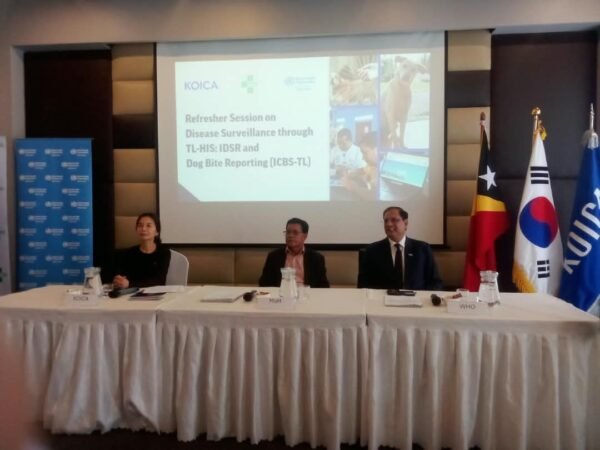
Dili, August 25, 2026 (Media Democracia) – The Ministry of Health works together with partners such as the World Health Organization and KOICA in Timor-Leste to facilitate a 2-day training for health professionals on how to use the digital system, specifically regarding the Timor-Leste Health Information System and Integrated Case-Based Surveillance of Timor-Leste, so that they can respond to public health emergencies and support the capacity development of health professionals.
In his speech, the Vice Minister for Institutional Strengthening of Health, Jose dos Reis Magno, said that today the Ministry of Health together with partners such as the World Health Organization and KOICA in Timor-Leste is facilitating training for health professionals on the Timor-Leste Health Information System and Integrated Case-Based Surveillance of Timor-Leste, which is being held for the second time the first was in 2025 and now with a special focus on surveillance of dog bites.
“WHO has become a trusted partner, especially in the areas of epidemiological surveillance, health information systems, preparedness and response to public health emergencies, and capacity development of health professionals, I also want to recognize and express gratitude to KOICA for its partnership and continuous support to the Ministry of Health’s efforts to strengthen health security, epidemiological surveillance, and the resilience of Timor-Leste’s health system.” said Vice Minister for Institutional Strengthening of Health Jose dos Reis Magno at City8, Tuesday (25/08).
He said the Ministry of Health is always working to build and ensure a public health system that is modern, resilient, integrated, and based on quality data.
“The Ministry of Health’s priority is the digital transformation of epidemiological surveillance, so we can improve the data system and provide information so that public health decisions can be based on timely, complete, reliable, and quality information.” he said.
The Timor-Leste Health Information System (TLHIS) supports routine indicator-based surveillance, while the Integrated Case-Based Surveillance platform (CBSTL) allows for notification, investigation, and follow-up of disease cases, including dog bites and other priority diseases.
“These systems have become an important step to modernize health information management in our country. But we must remember one very important thing. A digital system alone cannot improve public health. Technology is only effective when the professionals who use the system have capacity, commitment, and responsibility.” he stated.
He added that continued investment in people remains a priority for the Ministry of Health. It is important to note that this training is not a new activity, but a continuation of training held in 2025 at the CNE building with 170 participants.
“For this stage, the number of participants will remain the same, but it will be divided into four phases to facilitate the training process and give participants better opportunities to practice. This continued training is important because during implementation in the field, some focal points face difficulties using the system and procedures. In addition, some tablets used for work have been damaged or have technical problems, which affect data entry and notification.” he explained.
Therefore, this training continues to focus on the same topic, with special attention to the practical use of tablets and the Integrated Case-Based Surveillance system (ICBSTL), to update and strengthen the capacity of focal points. This is also important because there are some new focal points who need guidance and training to carry out their responsibilities well.
”The training starting today is not only to introduce new digital tools. This training is also to strengthen the technical competence of professionals in data entry, validation, analysis, and use of data, and to improve the quality and timeliness of notification. We also want to strengthen understanding of the surveillance information flow, from health facilities to municipal and national levels, to ensure that each piece of information reaches the appropriate level in a timely manner. Each case that is properly notified and investigated contributes to early detection of public health threats, rapid response to outbreaks, and better protection of our population. This is especially important for rabies.” he explained.
Therefore, he asked the focal points, whose role is extremely critical, working at the municipal level or in Community Health Centers. The goal is to ensure that the competencies gained in this training are actually applied in daily work, and that the use of TLHIS/DHIS2 and ICBSTL becomes an integral part of routine surveillance in Timor-Leste.
“You are the front line of our national surveillance system. The data you enter with quality, completeness, and timeliness into the system directly influences the Ministry of Health and Municipal Health Services’ ability to make evidence-based decisions. You will have the opportunity to review Integrated Disease Surveillance and Response (IDSR), notification flows, focal point responsibilities, review weekly and monthly reports, and especially the surveillance process for dog bites and rabies. I encourage all participants not to be afraid to ask questions, practice, identify difficulties, and share experiences. If there are problems with the system, we need to know. If there is a solution that works well in one municipality or Community Health Center, we need to share that solution with other colleagues.” he stated.
In the same place, WHO Representative in Timor-Leste Arvind Mathur stated that this is a refresher training on surveillance and disease response, because Timor-Leste continues to face emerging and re-emerging infectious diseases that pose epidemic risks.
“Therefore, timely and reliable surveillance data is essential for early detection. WHO has been working closely with the MoH to strengthen Timor-Leste’s surveillance system. We have developed an Integrated Case-Based Surveillance system to manage cases such as HIV, TB, Malaria, and dog bite cases, as well as other priority diseases.” said WHO Representative in Timor-Leste Arvind Mathur.
He said WHO supports the transition from weekly and monthly paper-based disease reporting under the Integrated Disease Surveillance and Response framework to an electronic system, which is an important achievement.
“But the timeliness and quality of data still need to be improved. Joint monitoring has identified key gaps, especially in digital use. Shifting from a paper-based surveillance system to an electronic surveillance system is an achievement, but the goal is to improve the data so that programs and policies are correctly oriented to protect citizens.” he said.
He explained that what is critical in surveillance is understanding the real situation to guide timely, evidence-based action.
Similarly, KOICA Country Director in Timor-Leste, Youn Hwa Kang, said KOICA is happy to continue working with the Ministry of Health to strengthen Timor-Leste’s disease surveillance system and support the development of a more accurate and responsive health information system.
“Timor-Leste has made important progress in transitioning from paper-based reporting to a more integrated digital monitoring system. Using DHIS2 and ICBS-TL, together with the introduction of digital equipment at the municipal health and community health center levels, provides an important foundation to improve the collection, reporting, and use of health information. This transition will help ensure that essential health data can be reported efficiently and support decision-making at local and national levels.” said KOICA Country Director in Timor-Leste, Youn Hwa Kang.
She said a strong surveillance system does not depend only on technology, but also on the people who use and manage it.
“Surveillance Focal Points play a critical role in ensuring that health information is accurately recorded, properly validated, and reported on time. That is why this refresher training provides an important opportunity to strengthen practical skills, clarify responsibilities, and reinforce consistent reporting practices across all municipalities. I hope this training will help participants gain more confidence in using DHIS2 and ICBS-TL in their daily work and contribute to improving the quality, completeness, and timeliness of surveillance data.” she said.
She added that the knowledge and experience gained here will ultimately support early detection of health risks and a more effective public health response. KOICA remains committed to supporting these efforts and to working with partners to build a stronger, more resilient, and sustainable health system.
Report By: Trainees Fizania and Santina
Photo: Fizania